
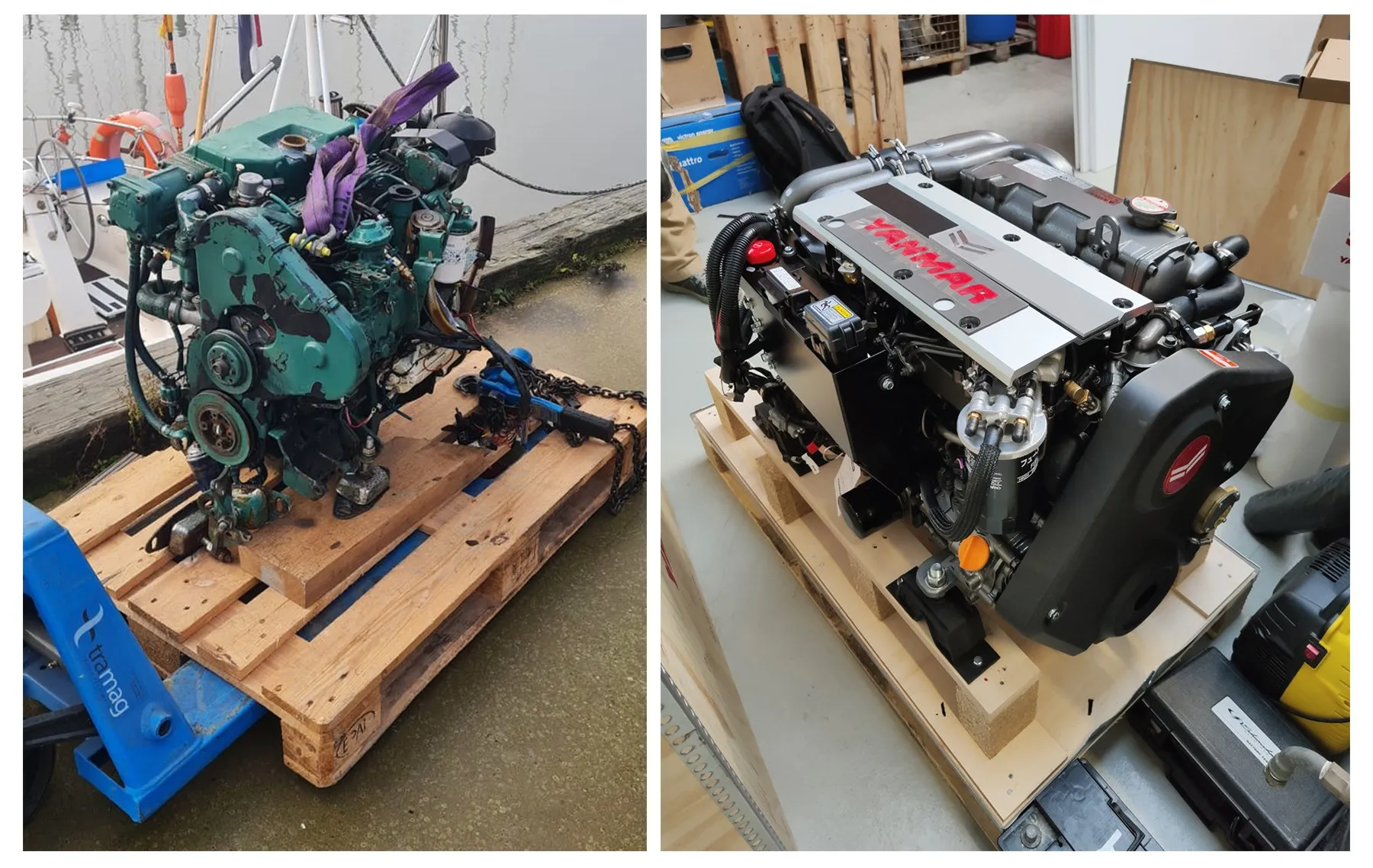
Marine diesel engines are not interchangeable simply because they produce similar horsepower. The right engine depends on the vessel’s displacement, propulsion arrangement, operating profile, required speed, available engine-room space, duty cycle, emissions requirements, service infrastructure and total lifecycle cost. The six manufacturers considered here also occupy different positions across the marine market. Yanmar’s current marine portfolio spans recreational, powerboat, light-duty commercial and commercial applications, with its leisure range extending from compact engines through high-output common-rail models. Volvo Penta offers marine engines for applications including inboard shaft, sailboat, sterndrive, IPS and auxiliary systems. Cummins covers recreational, commercial, government, fishing, passenger, offshore and other applications with propulsion and auxiliary power solutions. Caterpillar offers marine propulsion engines from relatively compact commercial models through very high-output propulsion platforms. MAN, now operating under the Everllence name following its rebranding, provides two-stroke and four-stroke propulsion solutions across a broad commercial marine spectrum, while mtu focuses heavily on high-performance integrated propulsion systems, with its current marine portfolio covering 720 to 10,000 kW.
That makes a simple ranking of these brands misleading. There is no single “best” marine diesel engine manufacturer for every vessel. A compact recreational boat has fundamentally different requirements from a commercial fishing vessel, offshore workboat, high-speed ferry, patrol craft or large ship. The better approach is to compare each manufacturer according to the application it is designed to serve, the engine architecture available in the required power class, installation requirements, emissions compliance, support network and expected operating profile. The most appropriate engine is the one that provides the required propulsion performance while delivering acceptable fuel consumption, reliability, serviceability and lifecycle economics for the vessel in question.
Yanmar: Strong Choice for Recreational, Powerboat and Light Commercial Applications
Yanmar has a particularly broad presence across smaller and mid-range marine propulsion. Its current marine engine range includes the GM, YM, JH-CR, 4LV, 8LV, 6LY-CR, 6LF and 6LT families, with the published recreational and light-duty range extending from compact engines to models rated at up to 640 MHP. Yanmar also provides dedicated application categories for sailboats and small craft, powerboats, light-duty commercial vessels and commercial marine applications. Its common-rail technology is used across engines from 40 to 640 MHP and combines electronically controlled high-pressure fuel injection with sensor-based engine management.
That breadth makes Yanmar particularly interesting for owners who need a compact propulsion package without moving immediately into the very large commercial-engine classes. Its smaller YM engines, for example, are specifically designed for smaller sailboats and pleasure craft, while its higher-output common-rail families extend into substantially larger powerboat and commercial applications. Yanmar also provides engine-selection tools that allow users to filter engines according to power, speed, certification and application. For a recreational vessel or light commercial boat where compact dimensions, fuel efficiency, serviceability and integrated marine systems are important, Yanmar can therefore be a very strong fit.
Volvo Penta: Integrated Propulsion and Ease of Vessel Operation
Volvo Penta takes a strongly integrated approach to marine propulsion. Its current marine-engine portfolio includes inboard shaft engines, Volvo Penta IPS propulsion, Aquamatic sterndrives, sailboat engines and marine auxiliary and generator applications. The manufacturer describes its marine engines around performance, reliability and durability while providing a range of propulsion configurations rather than treating the engine as an isolated power source.
This makes Volvo Penta particularly relevant when the propulsion system’s integration with the vessel is as important as the engine itself. For owners of boats designed around Volvo Penta’s propulsion architecture, compatibility between the engine, drive system, controls and vessel interface can be a major consideration. In a repower project, however, the existing propulsion configuration must be assessed carefully because changing the engine may involve changes to the transmission, shafting, controls and other components. The correct Volvo Penta solution is therefore determined by the complete propulsion arrangement rather than horsepower alone.
Cummins: Broad Coverage From Recreational to Heavy Commercial Marine
Cummins occupies a particularly broad section of the marine market. Its official marine portfolio includes advanced diesel and natural-gas engines, generator sets and other power solutions for recreational, commercial, government, fishing, passenger, yachting and offshore applications. The published range includes engines such as the QSK60 at 3,000 hp, KTA38 models from 850 to 1,500 hp and QSK95 models from 3,200 to 4,200 hp, illustrating the manufacturer’s presence in substantially higher-output propulsion applications.
One of Cummins’ major advantages for commercial operators is the breadth of its application and service infrastructure. The manufacturer explicitly provides marine support, warranty coverage, technical resources and access to marine experts, while its product portfolio is designed for applications ranging from light-duty recreational boats through demanding commercial and government platforms. This makes Cummins a logical consideration when the vessel requires substantial continuous or heavy-duty propulsion capability and the operator values a large established service ecosystem.
Caterpillar: Heavy-Duty Marine Power and Extensive Propulsion Range
Caterpillar’s marine portfolio extends from engines such as the C7.1 and C9.3 through large C18, C32, 3500-series and C280 propulsion engines. The published specifications demonstrate the enormous range within the Caterpillar marine family: the C7.1 commercial propulsion engine is rated from 280 to 425 bhp, the C18 reaches ratings as high as 1,136 bhp in its listed configurations, and the C280-16 reaches 6,169 to 8,046 bhp. This range allows Caterpillar to address very different vessel sizes and operating requirements.
Caterpillar also places considerable emphasis on electronic controls, common-rail fuel systems, diagnostics, emissions technology, marine classification and global dealer support. Its C7.1, for example, incorporates common-rail fuel injection, electronic control, compatibility with Cat displays and electronic systems, and heat-exchanger or keel-cooling options. At the high-output end, the 3516E provides ratings from 2,501 to 3,386 bhp and is offered with emissions configurations addressing EPA Tier 4 and IMO II/III requirements.
MAN: Large-Scale Commercial and Ship Propulsion
MAN, now presented by its parent organization as Everllence, occupies a particularly important position in large marine propulsion. Its portfolio includes both two-stroke and four-stroke propulsion engines, with the manufacturer describing its four-stroke engines around power efficiency, compactness, acceleration and low fuel consumption. Its broader marine portfolio is intended for applications ranging from smaller commercial vessels and tugs to large ships, while its two-stroke technology serves the much larger end of the marine propulsion market.
MAN’s strength becomes especially apparent when propulsion requirements move beyond conventional recreational or yacht applications into commercial shipping and large vessel operations. Its marine planning resources include engine-selection tools, installation drawings, project guides, technical papers and an extensive engine programme, demonstrating the degree of engineering consideration required for large propulsion systems. A recent MAN propulsion contract for Indian Navy fleet-support ships, for example, included 20V32/44CR marine engines together with reduction gearboxes, shaft generators, bow thrusters and controllable-pitch propeller systems, illustrating how its propulsion offering can extend well beyond the engine itself into complete vessel propulsion packages.
MTU: High-Performance Propulsion and Power Density
mtu is particularly associated with high-performance marine propulsion, where power density, low weight, compact dimensions, responsiveness and integrated system engineering can be decisive. Its current marine portfolio lists engines and generators from 720 to 10,000 kW, equivalent to approximately 965 to 13,410 bhp, while its propulsion systems can incorporate the gearbox, shaftline, propeller or waterjet and automation systems as part of an integrated solution.
The mtu approach is particularly relevant to high-speed and demanding vessels where the relationship between power, vessel weight and available installation space matters. The manufacturer identifies high power density, low weight, compact design, mechanical and thermal stability, straightforward maintenance and low lifecycle costs among the characteristics of its engines. Its Series 8000, for example, reaches up to 10 MW and has been used in high-speed ferries, naval ships and large yachts, demonstrating the type of demanding applications for which the platform was developed.
Comparing the Six Manufacturers by Application
Manufacturer Particularly Relevant Applications Key Considerations
Yanmar Recreational boats, sailboats, powerboats, light commercial Broad compact-to-high-output range, common rail, efficiency, serviceability
Volvo Penta Leisure boats, powerboats, sailboats, IPS, inboard shaft Integrated propulsion, controls and drive systems
Cummins Recreational, commercial, fishing, passenger, offshore, government Broad horsepower range and extensive marine support
Caterpillar Commercial, workboats, yachts, high-output propulsion Very broad power range, heavy-duty platforms and global support
MAN / Everllence Commercial ships, large vessels, tugs and major propulsion systems Two-stroke and four-stroke technology, large-scale propulsion engineering
mtu High-speed vessels, yachts, naval and demanding commercial applications High power density, integrated propulsion and high-performance systems
The table should not be interpreted as a rigid ranking because the manufacturers overlap in some applications while diverging substantially in others. A 200-hp recreational powerboat, a 1,500-hp workboat and a 10,000-kW high-speed vessel should not be evaluated using the same purchasing criteria. The correct comparison begins with the vessel’s required power and duty cycle, then narrows the field according to physical installation constraints, propulsion architecture, emissions requirements and support availability. The manufacturers’ own product structures demonstrate this differentiation: Yanmar organizes its range by applications including sailboat, powerboat and commercial marine, Cummins explicitly lists recreational through government and offshore applications, and Caterpillar separates commercial and high-performance propulsion products.
Which Brand Is Best for a Recreational Boat?
For a recreational boat, the decision will often narrow toward Yanmar, Volvo Penta, Cummins or Caterpillar depending on the vessel’s size and propulsion configuration. Yanmar’s range is particularly extensive in recreational and light-duty applications, including engines from compact sailboat units through higher-output common-rail powerboat engines. Volvo Penta has a similarly strong leisure position, particularly where IPS, sterndrive, sailboat or integrated electronic propulsion systems are involved. Cummins and Caterpillar become increasingly relevant as vessel size, horsepower and duty requirements rise.
The important distinction is that recreational use does not automatically mean low technical requirements. A high-performance yacht can place much greater demands on acceleration, power density, thermal management and propulsion integration than a slower commercial vessel. In those circumstances, an engine’s installation dimensions, power-to-weight ratio, control system and ability to integrate with the vessel can become more important than brand reputation alone.
Which Brand Is Best for Commercial Work?
Commercial operators generally place a greater emphasis on uptime, duty rating, fuel consumption, serviceability, parts availability and lifecycle economics. Cummins and Caterpillar have particularly broad commercial portfolios, while Yanmar addresses light-duty and commercial marine applications across its range. MAN and mtu become increasingly relevant as vessel size, power requirements and propulsion complexity move into larger commercial and high-performance categories.
For commercial operators, the engine should be evaluated according to the actual duty cycle rather than the maximum horsepower displayed on a specification sheet. A vessel operating continuously at high load has different requirements from one that operates intermittently, and an engine selected without sufficient consideration of its duty rating can produce an entirely different lifecycle outcome from the one expected at purchase.
Which Brand Is Best for High-Speed Vessels?
High-speed vessels place particular emphasis on power density, acceleration, weight and propulsion-system integration. mtu is especially prominent in this category, with its official marine portfolio emphasizing high power density and applications including high-speed vessels, while Caterpillar also offers dedicated high-performance propulsion engines such as the C18 and high-output C32 platforms. MAN’s four-stroke portfolio likewise emphasizes acceleration, power efficiency and compactness.
However, high-speed performance should never be judged from horsepower alone. The engine must be matched to the hull, reduction ratio, propeller or waterjet, vessel weight and operating RPM. A lower-weight engine producing the appropriate power at the correct operating speed can sometimes be more useful to a high-speed vessel than a heavier engine with a larger headline horsepower figure.
Fuel Efficiency: What Should Buyers Compare?
Fuel efficiency is often used as a simple brand-comparison metric, but real-world fuel consumption depends on the complete propulsion system and operating profile. Engine loading, vessel displacement, hull efficiency, propeller selection, transmission ratio, speed and sea conditions can all influence fuel consumption.
The manufacturers nevertheless place considerable emphasis on efficiency. Yanmar describes its common-rail technology as optimizing fuel delivery and efficiency, MAN identifies low fuel consumption and power efficiency as characteristics of its four-stroke propulsion engines, mtu emphasizes lower fuel consumption and lifecycle optimization, and Caterpillar’s modern marine engines incorporate electronically controlled fuel systems designed to optimize combustion.
The better purchasing question is therefore not “Which brand uses the least fuel?” but “Which engine delivers the required propulsion output at the vessel’s actual operating load with the lowest realistic lifecycle fuel cost?”
Technology and Electronic Controls
Technology varies significantly across these manufacturers and engine families. Yanmar’s common-rail system uses electronic control and multiple sensors to regulate fuel delivery according to operating conditions. Caterpillar uses electronic engine controls and common-rail systems on several current marine engines, while mtu integrates engine management with its NautIQ automation platform. Volvo Penta similarly builds electronic propulsion and control integration into its marine systems.
For an owner, the value of these systems is not simply technological sophistication. Electronic monitoring can provide better visibility into engine condition, support diagnostics and integrate propulsion information with other vessel systems. The trade-off is that modern electronically controlled engines can require specialized diagnostic equipment and appropriately trained service personnel, making support infrastructure an important part of the purchase decision.
Service Network and Parts Support
A marine engine’s value extends beyond its mechanical specifications. A technically excellent engine can become a poor commercial choice if critical parts, qualified technicians or diagnostic support are difficult to obtain in the vessel’s operating region.
Cummins explicitly provides global marine support and warranty coverage, Caterpillar maintains an extensive marine dealer network, Yanmar operates a global dealer and distributor network, and Volvo Penta provides dealer and technical support for its marine systems. mtu and MAN likewise support their larger propulsion platforms through specialized service and engineering structures.
For an owner operating internationally, this factor can be more important than a small difference in initial engine price. A vessel that depends on rapid access to filters, injectors, sensors, pumps or specialist technicians should prioritize the manufacturer with the strongest practical support network along its operating routes.
New Engine Selection: The Correct Method
The best way to select among Yanmar, Volvo Penta, Cummins, Caterpillar, MAN and mtu is to establish the vessel’s requirements first and compare engines second. Begin with vessel displacement, intended speed, propulsion configuration, annual operating hours and duty cycle. Then establish the required continuous and maximum power, rated RPM, available engine-room dimensions, engine weight, gearbox requirements, shaftline configuration, propeller or waterjet arrangement and applicable emissions requirements.
After those requirements are established, compare compatible engine families on fuel consumption, installation dimensions, service intervals, warranty, parts availability, diagnostic capability and projected lifecycle cost. Yanmar itself provides an engine-selection tool based on parameters such as power, speed and certifications, while MAN provides an engine-selection guide and planning resources for its larger propulsion products. These manufacturer tools reinforce the principle that engine selection is an engineering exercise rather than a popularity contest.
Final Verdict
Yanmar, Volvo Penta, Cummins, Caterpillar, MAN and mtu are all serious marine-engine manufacturers, but they should not be placed on a single linear scale from “best” to “worst.” Their portfolios are engineered around different combinations of vessel size, propulsion architecture, power requirements, operating profiles and system integration. Yanmar and Volvo Penta have particularly strong relevance across recreational and smaller-to-mid-range propulsion; Cummins and Caterpillar cover exceptionally broad recreational and commercial territory; MAN is particularly significant in large-scale commercial and ship propulsion; and mtu is especially prominent where high power density, high performance and integrated propulsion engineering are priorities.
The strongest engine is ultimately the one that matches the application, not the one with the most prestigious name. A buyer should evaluate the complete propulsion system, including engine rating, duty cycle, gearbox, shaftline, propeller, cooling, exhaust, controls, emissions compliance, service infrastructure and lifecycle cost. When those factors are matched correctly, each of these manufacturers can provide an appropriate solution for the right vessel.
The right marine engine is not simply the engine with the greatest power or the most recognizable badge. It is the engine engineered for the vessel, the workload and the waters in which it must perform.